
India Sri Lanka Defence Partnership & MAHASAGAR: Why Sri Lanka Matters to India’s Indian Ocean Strategy
UPSC Mains Syllabus Mapping
Paper: General Studies Paper II
Primary Subject: International Relations
Secondary Linkage: Maritime security, neighbourhood policy, regional groupings, disaster response, defence diplomacy and Indian Ocean geopolitics
Official Syllabus Linkage: India and its neighbourhood-relations; bilateral, regional and global groupings and agreements involving India; effect of policies and politics of countries on India’s interests.
Current Affairs Date: 6 September 2026
Primary Source: Ministry of Defence / PIB; Ministry of External Affairs
UPSC Relevance: Very High
Why in News?
On 6 September 2026, the Ministry of Defence announced that Raksha Mantri Rajnath Singh would undertake an official visit to Sri Lanka from 8–10 September 2026. The visit is expected to deepen bilateral cooperation in defence and maritime security and is framed within India’s Neighbourhood First policy and the wider vision of MAHASAGAR — Mutual and Holistic Advancement for Security and Growth Across Regions.
For UPSC, the news is important not because of the visit alone, but because it reveals a larger strategic shift: India–Sri Lanka relations are increasingly becoming a test case of how neighbourhood diplomacy, maritime security, capacity building and regional stability can be woven together.
The Core Idea in One Line
Sri Lanka is geographically close to India, strategically located in the Indian Ocean, economically intertwined with India, and operationally important for maritime security — making bilateral trust a national-security asset.
Think of the Relationship as a Maritime Triangle
Students can remember the relationship through three vertices:
- Geography: proximity, Palk Strait, Gulf of Mannar and major Indian Ocean sea lanes.
- Security: naval cooperation, surveillance, search and rescue, training and regional maritime coordination.
- Development: economic recovery support, connectivity, people-to-people links and capacity building.
UPSC insight: If any one side of this triangle weakens, the other two are also affected.
Why Sri Lanka Matters Strategically to India
- Location in the Indian Ocean: Sri Lanka sits close to important east–west shipping routes. Maritime developments around the island therefore have direct relevance for India’s trade and security environment.
- Southern maritime flank: Cooperation with Sri Lanka strengthens India’s ability to build a stable and cooperative security environment in the Indian Ocean Region.
- Non-traditional security threats: Search and rescue, maritime accidents, narcotics trafficking, illegal fishing, marine pollution and disaster response require cooperation across national boundaries.
- Neighbourhood stability: Political or economic instability in a close neighbour can produce humanitarian, migration, security and economic spillovers.
- Regional architecture: Sri Lanka is an important participant in frameworks such as the Colombo Security Conclave and broader Indian Ocean maritime cooperation.
Defence Cooperation: From Visits to Operational Capacity
India–Sri Lanka defence cooperation is not limited to ceremonial visits. Official bilateral documents identify several recurring pillars:
- Annual Defence Dialogue between Defence Secretaries;
- SLINEX bilateral naval exercise;
- MITRA SHAKTI bilateral army exercise;
- training and professional military education;
- Indian naval and coast guard ship visits;
- maritime surveillance cooperation;
- search-and-rescue infrastructure;
- humanitarian assistance and disaster response;
- service-to-service exchanges and capacity building.
Five Exam-Ready Facts You Should Remember
| Instrument / Initiative | Why it matters |
|---|---|
| Annual Defence Dialogue | Institutional mechanism to review and deepen bilateral defence cooperation. |
| SLINEX | India–Sri Lanka bilateral naval exercise. |
| MITRA SHAKTI | India–Sri Lanka bilateral army exercise. |
| Maritime Rescue Coordination Centre | Commissioned in Sri Lanka in June 2024 with an Indian grant; supports maritime search and rescue. |
| Dornier maritime surveillance support | Indian Navy Dornier aircraft has been operated by the Sri Lanka Air Force from Trincomalee since 2022 for maritime surveillance. |
India also offers roughly 1,200 training vacancies annually for Sri Lankan armed forces, showing that capacity building is a major component of the relationship.
2026: A Year of Intensifying Maritime Engagement
A useful way to understand the current trend is through a short timeline:
- April 2026: IN–SLN DIVEX deepened cooperation in complex underwater operations and submarine-rescue-related diving skills.
- May 2026: IOS SAGAR called at Colombo, reinforcing multinational maritime cooperation and the MAHASAGAR vision.
- June 2026: INS Sharda’s Colombo visit included training, first aid, firefighting and rescue-related exchanges.
- August 2026: Commander of the Sri Lanka Navy visited India for discussions on joint operations, training, capacity building and maritime security.
- September 2026: India’s Defence Minister announced a three-day Sri Lanka visit to carry forward strategic and defence engagement.
Pattern to note: the relationship is moving from episodic diplomacy towards repeated institutional and operational interaction.
What is MAHASAGAR?
MAHASAGAR stands for Mutual and Holistic Advancement for Security and Growth Across Regions. It expands India’s earlier maritime cooperative approach by emphasising security, growth, resilience, sustainability, capacity building and collective responsibility across regions.
For UPSC answers, avoid treating MAHASAGAR merely as a slogan. Use it as a framework to explain India’s preference for cooperative maritime security rather than unilateral maritime dominance.
SAGAR to MAHASAGAR: Conceptual Progression
| Dimension | SAGAR | MAHASAGAR |
|---|---|---|
| Core emphasis | Security and Growth for All in the Region | Mutual and holistic advancement for security and growth across regions |
| Primary lens | Indian Ocean cooperative security | Broader regional cooperation, resilience and shared maritime responsibility |
| UPSC use | India’s Indian Ocean policy | Evolving maritime diplomacy and wider security partnerships |
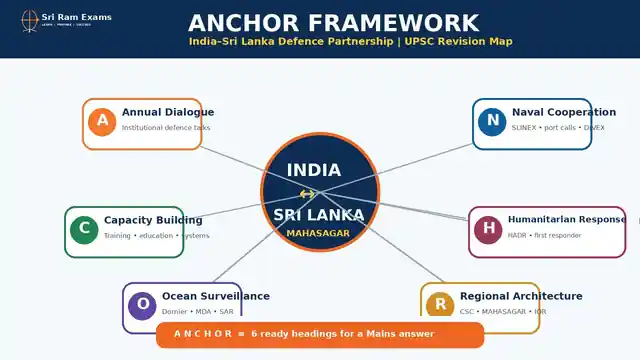
The ANCHOR Framework: Remember India–Sri Lanka Defence Ties
A – Annual Dialogue: regular institutional defence engagement.
N – Naval Cooperation: SLINEX, port calls, passage exercises and diving cooperation.
C – Capacity Building: training, professional education, equipment and maritime systems.
H – Humanitarian Response: disaster relief, marine emergencies and first-responder role.
O – Ocean Surveillance: maritime domain awareness, Dornier operations and search-and-rescue networks.
R – Regional Architecture: Colombo Security Conclave, MAHASAGAR and Indian Ocean cooperation.
This mnemonic can be directly converted into six subheadings in a Mains answer.
Maritime Security is More Than Warships
A mature UPSC answer should define maritime security broadly. It includes:
- safe sea lanes;
- maritime domain awareness;
- search and rescue;
- marine pollution response;
- anti-smuggling and anti-narcotics cooperation;
- illegal, unreported and unregulated fishing concerns;
- disaster response;
- port and coastal infrastructure security;
- cyber and communications resilience in maritime systems.
The Fisheries Dimension: A Test of Cooperative Federalism and Diplomacy
The fishermen issue in the Palk Bay is a recurring challenge. It has humanitarian, livelihood, legal, ecological and diplomatic dimensions. The long-term answer cannot rely only on arrests or diplomatic protests; it requires sustainable fishing practices, regular institutional dialogue, livelihood alternatives, marine-resource conservation and sensitivity to coastal communities on both sides.
UPSC analytical line: “A maritime boundary may be legally precise, but livelihoods at sea are socially and ecologically interconnected.”
Key Challenges in the Relationship
- Fishermen disputes: repeated incidents can create political and humanitarian friction.
- Strategic competition in the Indian Ocean: external power presence can complicate India’s security calculations.
- Trust deficit from historical experiences: perceptions in both countries require careful diplomatic management.
- Domestic political sensitivities: Tamil reconciliation and devolution remain politically significant.
- Economic vulnerability: Sri Lanka’s economic stability has direct implications for bilateral cooperation.
- Implementation gap: infrastructure and connectivity projects can be slowed by regulatory, financial or political constraints.
- Balancing sovereignty and security: cooperation must remain demand-driven, transparent and respectful of Sri Lankan sovereignty.
Why India’s ‘First Responder’ Role Matters
Official records highlight India’s role in responding to maritime emergencies and Sri Lanka’s economic and humanitarian needs. In maritime security, Indian Navy and Coast Guard interventions during incidents such as MV X-Press Pearl and MT New Diamond demonstrated that proximity gives India both responsibility and capability to respond quickly.
This creates strategic capital when it is paired with respect, reliability and sustained capacity building.
What Should India Do Next?
- institutionalise more joint maritime domain awareness and information sharing;
- expand coast guard and navy cooperation for non-traditional threats;
- strengthen search-and-rescue networks and disaster preparedness;
- continue capacity building without creating dependency;
- accelerate mutually beneficial connectivity and energy projects;
- use fisheries dialogue to move from crisis management to resource co-management;
- deepen people-to-people, Buddhist, educational and cultural links;
- keep security cooperation transparent and sovereignty-sensitive;
- link MAHASAGAR with regional institutions rather than treating it as a stand-alone doctrine.
How to Draw This in the Exam
In 20 seconds, draw a small outline map showing South India → Palk Strait → Sri Lanka. Add four arrows labelled Trade Routes, Maritime Security, Fisheries, Connectivity. This instantly converts a descriptive answer into a geographical-strategic answer.
Revision Mind Map
India–Sri Lanka proximity → shared maritime space → trade routes + fisheries + security threats → defence dialogue + SLINEX + MITRA SHAKTI + MRCC + surveillance + HADR → trust and interoperability → stable Indian Ocean → Neighbourhood First + MAHASAGAR.
60-Second Notes
- Defence Minister’s Sri Lanka visit: 8–10 September 2026.
- Core policies: Neighbourhood First + MAHASAGAR.
- SLINEX = Naval exercise; MITRA SHAKTI = Army exercise.
- MRCC in Sri Lanka: Indian grant; commissioned in June 2024.
- Dornier aircraft support: maritime surveillance from Trincomalee since 2022.
- India offers around 1,200 annual training vacancies to Sri Lankan armed forces.
- Best Mains framework: ANCHOR — Annual dialogue, Naval cooperation, Capacity building, Humanitarian response, Ocean surveillance, Regional architecture.
UPSC Mains Practice Question
“India–Sri Lanka relations are no longer only a bilateral neighbourhood issue; they have become central to India’s maritime security architecture in the Indian Ocean.” Discuss. (250 words, GS Paper II)
Answer Framework: geographical significance → current visit → defence mechanisms → maritime-security dimensions → MAHASAGAR and regional architecture → challenges → sovereignty-sensitive and cooperative way forward.
Prelims Check
Q1. Consider the following pairs:
- SLINEX — India–Sri Lanka Naval Exercise
- MITRA SHAKTI — India–Sri Lanka Army Exercise
- MAHASAGAR — Mutual and Holistic Advancement for Security and Growth Across Regions
How many of the pairs given above are correctly matched?
(a) Only one
(b) Only two
(c) All three
(d) None
Answer: (c)
Q2. The Maritime Rescue Coordination Centre established in Sri Lanka with Indian assistance is primarily associated with:
(a) Nuclear material monitoring
(b) Maritime search and rescue coordination
(c) Customs tariff harmonisation
(d) Deep-sea mineral licensing
Answer: (b)
Related Practice on Sri Ram Exams
Official Sources
भारत–श्रीलंका रक्षा साझेदारी और महासागर: हिंद महासागर में भारत की सुरक्षा रणनीति
यूपीएससी मुख्य परीक्षा पाठ्यक्रम मानचित्रण
पेपर: सामान्य अध्ययन पेपर II
प्रमुख विषय: अंतरराष्ट्रीय संबंध
द्वितीयक संबंध: समुद्री सुरक्षा, पड़ोसी प्रथम नीति, क्षेत्रीय समूह, आपदा प्रतिक्रिया, रक्षा कूटनीति और हिंद महासागर भू-राजनीति
आधिकारिक पाठ्यक्रम संबंध: भारत और उसके पड़ोसी देशों से संबंध; भारत से संबंधित द्विपक्षीय, क्षेत्रीय तथा वैश्विक समूह और समझौते; भारत के हितों पर अन्य देशों की नीतियों और राजनीति का प्रभाव।
करंट अफेयर्स तिथि: 6 सितंबर 2026
प्राथमिक स्रोत: रक्षा मंत्रालय / प्रेस सूचना ब्यूरो; विदेश मंत्रालय
यूपीएससी प्रासंगिकता: अत्यंत उच्च
चर्चा में क्यों?
6 सितंबर 2026 को रक्षा मंत्रालय ने घोषणा की कि रक्षा मंत्री राजनाथ सिंह 8 से 10 सितंबर 2026 तक श्रीलंका की आधिकारिक यात्रा करेंगे। यह यात्रा रक्षा और समुद्री सुरक्षा सहयोग को आगे बढ़ाने तथा भारत की पड़ोसी प्रथम नीति और व्यापक महासागर (MAHASAGAR — Mutual and Holistic Advancement for Security and Growth Across Regions) दृष्टि को मजबूत करने के संदर्भ में महत्त्वपूर्ण है।
यूपीएससी के लिए महत्त्व केवल यात्रा में नहीं है। यह एक बड़े परिवर्तन को दर्शाता है—भारत–श्रीलंका संबंध अब पड़ोसी कूटनीति, समुद्री सुरक्षा, क्षमता निर्माण और क्षेत्रीय स्थिरता को एक ही ढाँचे में जोड़ने का उदाहरण बन रहे हैं।
एक पंक्ति में मूल विचार
श्रीलंका भारत के निकट है, हिंद महासागर में रणनीतिक स्थान रखता है, भारत से आर्थिक रूप से जुड़ा है और समुद्री सुरक्षा में परिचालन सहयोगी है; इसलिए द्विपक्षीय विश्वास स्वयं एक राष्ट्रीय-सुरक्षा परिसंपत्ति है।
संबंध को ‘समुद्री त्रिकोण’ की तरह याद रखें
- भूगोल: निकटता, पाक जलडमरूमध्य, मन्नार की खाड़ी और महत्त्वपूर्ण हिंद महासागरीय समुद्री मार्ग।
- सुरक्षा: नौसैनिक सहयोग, निगरानी, खोज एवं बचाव, प्रशिक्षण और क्षेत्रीय समुद्री समन्वय।
- विकास: आर्थिक सहयोग, संपर्क, जन-से-जन संबंध और क्षमता निर्माण।
यूपीएससी दृष्टि: इस त्रिकोण की एक भुजा कमजोर होने पर बाकी दोनों भी प्रभावित होती हैं।
भारत के लिए श्रीलंका रणनीतिक रूप से क्यों महत्त्वपूर्ण है?
- हिंद महासागर में स्थिति: श्रीलंका महत्त्वपूर्ण पूर्व–पश्चिम समुद्री मार्गों के निकट स्थित है। इसलिए द्वीप के आसपास की समुद्री गतिविधियों का भारत के व्यापार और सुरक्षा वातावरण से सीधा संबंध है।
- दक्षिणी समुद्री परिक्षेत्र: श्रीलंका के साथ सहयोग हिंद महासागर में स्थिर और सहयोगात्मक सुरक्षा वातावरण बनाने में सहायक है।
- गैर-पारंपरिक सुरक्षा खतरे: खोज एवं बचाव, समुद्री दुर्घटनाएँ, मादक पदार्थों की तस्करी, अवैध मत्स्यन, समुद्री प्रदूषण और आपदा प्रतिक्रिया सीमा-पार सहयोग माँगते हैं।
- पड़ोसी स्थिरता: निकट पड़ोसी की राजनीतिक या आर्थिक अस्थिरता के मानवीय, प्रवासन, सुरक्षा और आर्थिक प्रभाव भारत तक पहुँच सकते हैं।
- क्षेत्रीय सुरक्षा ढाँचा: श्रीलंका कोलंबो सुरक्षा सम्मेलन और व्यापक हिंद महासागर सहयोग का महत्त्वपूर्ण भागीदार है।
रक्षा सहयोग: यात्राओं से आगे परिचालन क्षमता तक
भारत–श्रीलंका रक्षा सहयोग केवल उच्चस्तरीय यात्राओं तक सीमित नहीं है। इसके प्रमुख स्तंभ हैं:
- रक्षा सचिवों के बीच वार्षिक रक्षा संवाद;
- स्लाइनेक्स (SLINEX) द्विपक्षीय नौसैनिक अभ्यास;
- मित्र शक्ति द्विपक्षीय थलसेना अभ्यास;
- प्रशिक्षण और व्यावसायिक सैन्य शिक्षा;
- भारतीय नौसेना और तटरक्षक पोतों की यात्राएँ;
- समुद्री निगरानी सहयोग;
- खोज एवं बचाव अवसंरचना;
- मानवीय सहायता और आपदा प्रतिक्रिया;
- सेना-से-सेना संपर्क और क्षमता निर्माण।
परीक्षा के लिए पाँच तथ्य
| व्यवस्था / पहल | क्यों महत्त्वपूर्ण? |
|---|---|
| वार्षिक रक्षा संवाद | द्विपक्षीय रक्षा सहयोग की समीक्षा और विस्तार का संस्थागत माध्यम। |
| स्लाइनेक्स | भारत–श्रीलंका द्विपक्षीय नौसैनिक अभ्यास। |
| मित्र शक्ति | भारत–श्रीलंका द्विपक्षीय थलसेना अभ्यास। |
| समुद्री बचाव समन्वय केंद्र | भारत की अनुदान सहायता से श्रीलंका में जून 2024 में शुरू; समुद्री खोज एवं बचाव में सहायक। |
| डोर्नियर समुद्री निगरानी सहयोग | 2022 से त्रिंकोमाली में श्रीलंका वायुसेना द्वारा भारतीय नौसेना के डोर्नियर विमान का समुद्री निगरानी हेतु संचालन। |
भारत श्रीलंका के सशस्त्र बलों के लिए प्रतिवर्ष लगभग 1,200 प्रशिक्षण स्थान भी उपलब्ध कराता है, जो क्षमता निर्माण के महत्त्व को दर्शाता है।
2026: समुद्री सहयोग तेजी से गहरा हुआ
- अप्रैल 2026: भारत–श्रीलंका डाइविंग अभ्यास ने जटिल जलमग्न अभियानों और पनडुब्बी-बचाव से संबंधित कौशल में सहयोग बढ़ाया।
- मई 2026: आईओएस सागर ने कोलंबो बंदरगाह का दौरा किया और महासागर दृष्टि के तहत बहुराष्ट्रीय समुद्री सहयोग को आगे बढ़ाया।
- जून 2026: आईएनएस शारदा की कोलंबो यात्रा में प्रशिक्षण, प्राथमिक उपचार, अग्निशमन और बचाव प्रक्रियाओं पर आदान-प्रदान हुआ।
- अगस्त 2026: श्रीलंका नौसेना के कमांडर ने भारत का दौरा कर संयुक्त संचालन, प्रशिक्षण, क्षमता निर्माण और समुद्री सुरक्षा पर चर्चा की।
- सितंबर 2026: भारत के रक्षा मंत्री की तीन-दिवसीय श्रीलंका यात्रा की घोषणा हुई।
पैटर्न: संबंध कभी-कभार होने वाली कूटनीति से आगे बढ़कर नियमित संस्थागत और परिचालन सहयोग की दिशा में जा रहे हैं।
महासागर क्या है?
महासागर (MAHASAGAR) का पूर्ण रूप है Mutual and Holistic Advancement for Security and Growth Across Regions। इसकी मूल भावना सुरक्षा, विकास, लचीलापन, सततता, क्षमता निर्माण और साझा समुद्री उत्तरदायित्व को जोड़ना है।
मेन्स उत्तर में इसे केवल नारे की तरह न लिखें। इसे भारत की सहयोगात्मक समुद्री सुरक्षा की अवधारणा के रूप में प्रस्तुत करें।
सागर से महासागर: अवधारणा का विस्तार
| आयाम | सागर | महासागर |
|---|---|---|
| मूल बल | क्षेत्र में सभी के लिए सुरक्षा और विकास | क्षेत्रों के पार सुरक्षा और विकास के लिए परस्पर एवं समग्र प्रगति |
| प्रमुख दृष्टि | हिंद महासागर में सहयोगात्मक सुरक्षा | व्यापक क्षेत्रीय सहयोग, लचीलापन और साझा समुद्री उत्तरदायित्व |
| यूपीएससी उपयोग | भारत की हिंद महासागर नीति | विकसित होती समुद्री कूटनीति और व्यापक सुरक्षा साझेदारियाँ |
ANCHOR ढाँचा: भारत–श्रीलंका रक्षा संबंध याद रखने की युक्ति
A – वार्षिक संवाद: नियमित संस्थागत रक्षा संपर्क।
N – नौसैनिक सहयोग: स्लाइनेक्स, बंदरगाह यात्राएँ और डाइविंग सहयोग।
C – क्षमता निर्माण: प्रशिक्षण, व्यावसायिक शिक्षा, उपकरण और समुद्री प्रणालियाँ।
H – मानवीय प्रतिक्रिया: आपदा राहत, समुद्री आपातस्थिति और प्रथम प्रतिक्रियाकर्ता की भूमिका।
O – महासागरीय निगरानी: समुद्री क्षेत्र जागरूकता, डोर्नियर संचालन और खोज-बचाव तंत्र।
R – क्षेत्रीय ढाँचा: कोलंबो सुरक्षा सम्मेलन, महासागर और हिंद महासागर सहयोग।
इसी ढाँचे की छह शाखाएँ मेन्स उत्तर में छह उपशीर्षक बन सकती हैं।
समुद्री सुरक्षा केवल युद्धपोत नहीं है
- सुरक्षित समुद्री मार्ग;
- समुद्री क्षेत्र जागरूकता;
- खोज एवं बचाव;
- समुद्री प्रदूषण प्रतिक्रिया;
- तस्करी और मादक पदार्थ विरोधी सहयोग;
- अवैध, अनियमित और अनियंत्रित मत्स्यन की समस्या;
- आपदा प्रतिक्रिया;
- बंदरगाह और तटीय अवसंरचना सुरक्षा;
- समुद्री प्रणालियों में साइबर और संचार लचीलापन।
मछुआरा प्रश्न: कूटनीति और आजीविका का मिलन-बिंदु
पाक खाड़ी में मछुआरों का मुद्दा बार-बार तनाव उत्पन्न करता है। इसमें मानवीय, आजीविका, विधिक, पारिस्थितिक और कूटनीतिक आयाम एक साथ जुड़े हैं। दीर्घकालिक समाधान केवल गिरफ्तारी या विरोध-पत्र नहीं हो सकता; इसके लिए टिकाऊ मत्स्यन, नियमित संस्थागत वार्ता, वैकल्पिक आजीविका, समुद्री संसाधन संरक्षण और दोनों पक्षों के तटीय समुदायों के प्रति संवेदनशीलता आवश्यक है।
मेन्स में उपयोगी पंक्ति: “समुद्री सीमा विधिक रूप से स्पष्ट हो सकती है, किंतु समुद्र पर निर्भर आजीविकाएँ सामाजिक और पारिस्थितिक रूप से परस्पर जुड़ी रहती हैं।”
प्रमुख चुनौतियाँ
- मछुआरा विवाद: बार-बार होने वाली घटनाएँ मानवीय और राजनीतिक तनाव बढ़ा सकती हैं।
- हिंद महासागर में रणनीतिक प्रतिस्पर्धा: बाहरी शक्तियों की उपस्थिति भारत की सुरक्षा गणना को जटिल बना सकती है।
- ऐतिहासिक अनुभवों से बना अविश्वास: दोनों देशों में धारणाओं का सावधानी से प्रबंधन आवश्यक है।
- घरेलू राजनीतिक संवेदनशीलता: तमिल पुनर्मिलन और अधिकार-विकेंद्रीकरण राजनीतिक रूप से महत्त्वपूर्ण विषय हैं।
- आर्थिक संवेदनशीलता: श्रीलंका की आर्थिक स्थिरता का द्विपक्षीय सहयोग पर सीधा प्रभाव पड़ता है।
- कार्यान्वयन अंतर: संपर्क और अवसंरचना परियोजनाएँ नियामकीय, वित्तीय या राजनीतिक कारणों से धीमी हो सकती हैं।
- संप्रभुता–सुरक्षा संतुलन: सहयोग मांग-आधारित, पारदर्शी और श्रीलंका की संप्रभुता के प्रति सम्मानपूर्ण होना चाहिए।
भारत की ‘प्रथम प्रतिक्रियाकर्ता’ भूमिका क्यों महत्त्वपूर्ण है?
आधिकारिक अभिलेख बताते हैं कि भारत ने समुद्री आपातस्थितियों और मानवीय संकटों में श्रीलंका की सहायता की है। एमवी एक्स-प्रेस पर्ल तथा एमटी न्यू डायमंड जैसी समुद्री घटनाओं में भारतीय नौसेना और तटरक्षक की सहायता ने दिखाया कि भौगोलिक निकटता भारत को त्वरित प्रतिक्रिया की क्षमता और उत्तरदायित्व दोनों देती है।
जब यह भूमिका विश्वसनीयता, सम्मान और दीर्घकालिक क्षमता निर्माण से जुड़ती है, तब यह भारत के लिए रणनीतिक विश्वास पैदा करती है।
भारत को आगे क्या करना चाहिए?
- समुद्री क्षेत्र जागरूकता और सूचना साझेदारी को और संस्थागत बनाना;
- गैर-पारंपरिक खतरों के लिए नौसेना और तटरक्षक सहयोग बढ़ाना;
- खोज-बचाव और आपदा तैयारी तंत्र मजबूत करना;
- निर्भरता पैदा किए बिना क्षमता निर्माण जारी रखना;
- परस्पर लाभकारी संपर्क और ऊर्जा परियोजनाओं को गति देना;
- मछुआरा मुद्दे को संकट प्रबंधन से संसाधन-सहप्रबंधन की दिशा में ले जाना;
- शिक्षा, बौद्ध विरासत, संस्कृति और जन-से-जन संपर्क को गहरा करना;
- सुरक्षा सहयोग को पारदर्शी और संप्रभुता-संवेदनशील रखना;
- महासागर दृष्टि को क्षेत्रीय संस्थाओं से जोड़ना।
परीक्षा में इसे कैसे चित्रित करें?
20 सेकंड में छोटा-सा रेखाचित्र बनाएँ: दक्षिण भारत → पाक जलडमरूमध्य → श्रीलंका। चार तीर लिखें—व्यापार मार्ग, समुद्री सुरक्षा, मत्स्यन, संपर्क। इससे वर्णनात्मक उत्तर तुरंत भूगोल-संवेदी रणनीतिक उत्तर में बदल जाता है।
पुनरावृत्ति माइंड मैप
भारत–श्रीलंका निकटता → साझा समुद्री क्षेत्र → व्यापार मार्ग + मत्स्यन + सुरक्षा खतरे → रक्षा संवाद + स्लाइनेक्स + मित्र शक्ति + समुद्री बचाव समन्वय केंद्र + निगरानी + मानवीय सहायता → विश्वास और अंतर-संचालनीयता → स्थिर हिंद महासागर → पड़ोसी प्रथम + महासागर।
60 सेकंड में नोट्स
- रक्षा मंत्री की श्रीलंका यात्रा: 8–10 सितंबर 2026।
- मूल नीतियाँ: पड़ोसी प्रथम + महासागर।
- स्लाइनेक्स = नौसैनिक अभ्यास; मित्र शक्ति = थलसेना अभ्यास।
- समुद्री बचाव समन्वय केंद्र: भारतीय अनुदान; जून 2024 में शुरू।
- डोर्नियर सहयोग: 2022 से त्रिंकोमाली से समुद्री निगरानी।
- श्रीलंकाई सशस्त्र बलों के लिए भारत लगभग 1,200 वार्षिक प्रशिक्षण स्थान देता है।
- श्रेष्ठ मेन्स ढाँचा: ANCHOR — वार्षिक संवाद, नौसैनिक सहयोग, क्षमता निर्माण, मानवीय प्रतिक्रिया, महासागरीय निगरानी, क्षेत्रीय ढाँचा।
यूपीएससी मेन्स अभ्यास प्रश्न
“भारत–श्रीलंका संबंध अब केवल द्विपक्षीय पड़ोसी संबंध नहीं रह गए हैं; वे हिंद महासागर में भारत की समुद्री सुरक्षा संरचना के केंद्र में आ गए हैं।” चर्चा कीजिए। (250 शब्द, सामान्य अध्ययन पेपर II)
उत्तर रूपरेखा: भौगोलिक महत्त्व → वर्तमान यात्रा → रक्षा तंत्र → समुद्री सुरक्षा आयाम → महासागर और क्षेत्रीय ढाँचा → चुनौतियाँ → संप्रभुता-संवेदनशील सहयोगात्मक आगे की राह।
प्रीलिम्स जाँच
प्रश्न 1. निम्नलिखित युग्मों पर विचार कीजिए:
- स्लाइनेक्स — भारत–श्रीलंका नौसैनिक अभ्यास
- मित्र शक्ति — भारत–श्रीलंका थलसेना अभ्यास
- महासागर — Mutual and Holistic Advancement for Security and Growth Across Regions
उपर्युक्त में कितने युग्म सही सुमेलित हैं?
(a) केवल एक
(b) केवल दो
(c) सभी तीन
(d) कोई नहीं
उत्तर: (c)
प्रश्न 2. भारत की सहायता से श्रीलंका में स्थापित समुद्री बचाव समन्वय केंद्र का प्रमुख उद्देश्य किससे संबंधित है?
(a) परमाणु सामग्री निगरानी
(b) समुद्री खोज एवं बचाव समन्वय
(c) सीमा शुल्क दरों का सामंजस्य
(d) गहरे समुद्र में खनिज लाइसेंसिंग
उत्तर: (b)
श्री राम एग्जाम्स पर संबंधित अभ्यास
आधिकारिक स्रोत
- रक्षा मंत्रालय / प्रेस सूचना ब्यूरो: रक्षा मंत्री की श्रीलंका यात्रा — 6 सितंबर 2026
- विदेश मंत्रालय: भारत–श्रीलंका द्विपक्षीय संबंध संक्षिप्त विवरण
- रक्षा मंत्रालय / प्रेस सूचना ब्यूरो: भारत–श्रीलंका डाइविंग अभ्यास 2026
- रक्षा मंत्रालय / प्रेस सूचना ब्यूरो: श्रीलंका नौसेना कमांडर की भारत यात्रा — अगस्त 2026
Prelims Perspective
MAHASAGAR; SLINEX; MITRA SHAKTI; Maritime Rescue Coordination Centre; Dornier maritime surveillance; Colombo Security Conclave.
प्रीलिम्स दृष्टिकोण
प्रश्न 1. निम्नलिखित युग्मों पर विचार कीजिए: स्लाइनेक्स — भारत–श्रीलंका नौसैनिक अभ्यास मित्र शक्ति — भारत–श्रीलंका थलसेना अभ्यास महासागर — Mutual and Holistic Advancement for Security and Growth Across Regions उपर्युक्त में कितने युग्म सही सुमेलित हैं? (a) केवल एक (b) केवल दो (c) सभी तीन (d) कोई नहीं उत्तर: (c) प्रश्न 2. भारत की सहायता से श्रीलंका में स्थापित समुद्री बचाव समन्वय केंद्र का प्रमुख उद्देश्य किससे संबंधित है? (a) परमाणु सामग्री निगरानी (b)…
Mains Perspective
Very High: India–Sri Lanka relations, Indian Ocean strategy, maritime security, defence diplomacy, Neighbourhood First, MAHASAGAR, fisheries and regional cooperation.
मेन्स दृष्टिकोण
“भारत–श्रीलंका संबंध अब केवल द्विपक्षीय पड़ोसी संबंध नहीं रह गए हैं; वे हिंद महासागर में भारत की समुद्री सुरक्षा संरचना के केंद्र में आ गए हैं।” चर्चा कीजिए। (250 शब्द, सामान्य अध्ययन पेपर II) उत्तर रूपरेखा: भौगोलिक महत्त्व → वर्तमान यात्रा → रक्षा तंत्र → समुद्री सुरक्षा आयाम → महासागर और क्षेत्रीय ढाँचा → चुनौतियाँ → संप्रभुता-संवेदनशील सहयोगात्मक आगे की राह।

Goldej Kumar is the Founder and Editor of Sri Ram Exams (Exam2.in), an independent educational platform for UPSC, State Public Service Commission, SSC and other competitive examinations. His editorial focus is on exam-relevant current affairs, source-based analysis, MCQ reasoning, previous-year-question patterns and clear bilingual learning for English- and Hindi-medium aspirants.